Annonce
How LINAGORA is Building Open AI Models for Europe With NVIDIA Nemotron
À J-2 du Paris Open Source AI Summit, LINAGORA célèbre le renforcement de sa collaboration avec NVIDIA autour des modèles Luciole. À lire sur le blog Linagora, en anglais.
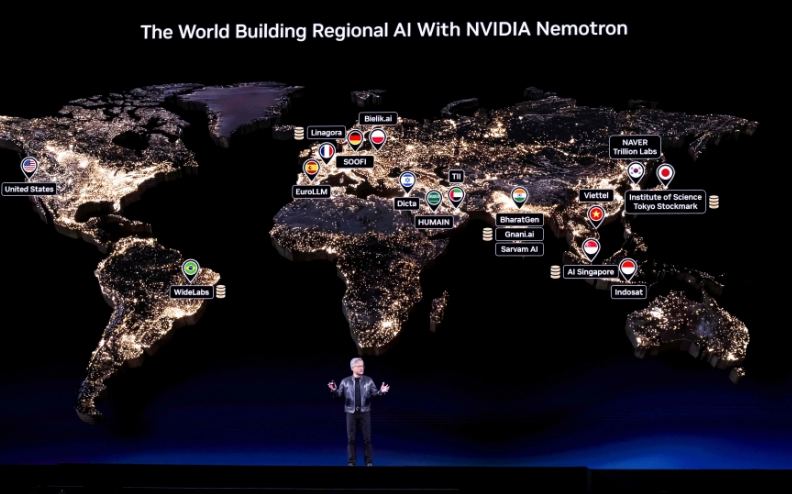
À J-2 du Paris Open Source AI Summit (POSAIS), nous sommes très heureux de célébrer notre coopération renforcée avec NVIDIA. NVIDIA sera présent au POSAIS à la fois pour une table ronde et pour une démo d’OpenClaw couplé à un SLM de la famille Nemotron, aux côtés de LINAGORA.
At LINAGORA and OpenLLM France, we are creating truly open multilingual foundation models that give European developers full transparency, control and deployment choice.
We believe European developers need AI models that reflect the languages, data practices, and deployment requirements of the people who use them. Developers also need to understand how a model is trained, adapt it to local needs, and deploy it where data and operations remain under their control.
Through OpenLLM France, we are working with academic and industry partners like NVIDIA to build open, transparent, ethical AI with an emphasis on French and European languages. With GENCI and AI Factory France’s support (access to the Jean Zay supercomputer, IDRIS - CNRS) we are showing how a regional model builder can turn public compute and open infrastructure into practical choices for developers, researchers and public-sector organizations.
From Lucie to Luciole
Our work began with Lucie 7B, a foundation model trained from scratch with support from GENCI and IDRIS. We have since expanded this work with Luciole, a family of pretrained models focusing on European Languages available in three configurations:
- Luciole-1B gives us an SLM for edge and resource-constrained environments.
- Luciole-8B is designed with a hybrid Mamba-Transformer architecture for memory-efficient long-context processing.
- Luciole-23B provides greater capacity for fine-tuning and task adaptation.
As these are foundation models and not finished chat assistants, they afford developers a clear starting point for building specialized applications rather than being locked into a single experience or provider.
Open means more than open weights
At LINAGORA, we extend openness beyond open weights. Through OpenLLM France, we publish model checkpoints, training data, and the code used for data processing and model training. We also release intermediate checkpoints, making the development process more inspectable. The Luciole model cards, including the Luciole-23B model card, document a multilingual training corpus of around 5 trillion tokens. The models cover major European languages, with a particular emphasis on English and French, with all Luciole models being released under the Apache 2.0 license.
This transparency gives researchers and developers an auditable starting point. They can evaluate the data and training process, reproduce parts of the work and adapt the models for downstream use. It also helps us contribute to a European AI ecosystem in which knowledge and infrastructure can be shared rather than concentrated in a small number of proprietary platforms.
Built for deployment choice
For public-sector and regulated organizations, data location, auditability and long-term control are part of system design. Our model work is part of a broader open-source ecosystem that includes OpenRAG, Twake.ai and LinTO. Together, these projects reflect our goal of extending open model development to practical applications and services.
A shared open-source direction
NVIDIA Nemotron reflects a principle we share: open models, transparent and reliable data and tools that help organizations build, build customize and deploy AI across environments. NVIDIA makes Nemotron models, datasets and techniques available for research and commercial use, from local PCs to enterprise-scale systems. These capabilities give us more options for building, adapting and operating AI while keeping our own open-source work at the center.
All Luciole models have architectures adapted from Nemotron. Each of Luciole model cards documents a custom adaptation of the Nemotron 3 Nano model training recipe and credits training with NVIDIA NeMo on Jean Zay’s H100 partition. By combining community-developed data (including NVIDIA Nemotron datasets) and models with open software and accelerated infrastructure, we can build models that are relevant to European languages and priorities while remaining open to evaluation and adaptation.
An example for Europe’s AI ecosystem
We believe regional model builders connect technical progress to local context. Through LINAGORA and OpenLLM France, we are showing how open data, model checkpoints, training code and public compute can work together to produce models relevant to the European community. Our work gives developers a trusted alternative to opaque, proprietary systems while preserving the freedom to evaluate, adapt, and deploy.
At LINAGORA, working with open technology means giving organizations greater control over their AI choices. For Europe, it means more developers can participate in AI creation, contributing to shared infrastructure to build systems that reflect local needs.
As open model ecosystems grow, we see an opportunity to combine global scale with regional relevance. Our aim is an AI landscape in which European developers can build software with open foundations, understand what they are using, and deploy it where it creates the most value.
Explore our Luciole models on Hugging Face and the training code on GitHub.
Commentaires
Réponses imbriquées possibles. Vous commentez en tant qu'invité : choisissez un pseudo, et c'est tout. Modération a posteriori : tout est publié immédiatement, je peux retirer si besoin.